


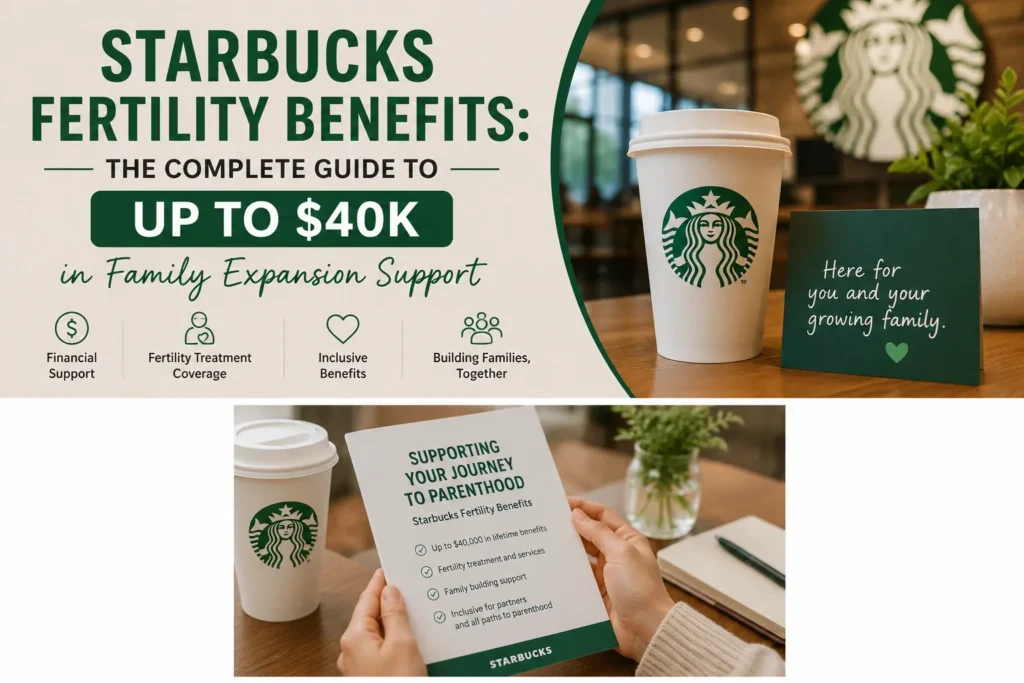
Starbucks Fertility Benefits: The Complete Guide to Up to $40K in Family Expansion Support
Starbucks fertility benefits for millions of Americans, the cost of starting a family through IVF, surrogacy, or adoption isn’t just daunting it can be completely out of reach. A single IVF cycle averages $12,400 before medications, and most people need more than one. Surrogacy can exceed $150,000. Domestic adoption routinely runs $30,000 to $50,000.
Which is exactly why tens of thousands of people have done something that surprises most: they applied for a barista job at Starbucks.
Starbucks is one of the very few major U.S. employers and arguably the most well-known to offer comprehensive fertility and family-building benefits to both full-time and part-time employees. The program includes up to $25,000 for fertility treatments like IVF through the medical plan, plus a separate Family Expansion Reimbursement of up to $40,000 for adoption and surrogacy costs.
This guide breaks down exactly what Starbucks covers, who qualifies, how to access the benefits, and whether it’s realistically worth it including the things most articles won’t tell you.
What Most People Get Wrong About Starbucks Fertility Benefits
Before diving into the details, it’s worth clearing up the single most common point of confusion: Starbucks does not have one fertility benefit it has two, and they work very differently.
| Benefit Layer | What It Covers | Maximum |
|---|---|---|
| Medical Plan Fertility Coverage | IVF, IUI, egg freezing, fertility medications | $25,000 (services) + $10,000 (Rx) |
| Family Expansion Reimbursement | Adoption, surrogacy (medical & non-medical) | $40,000 lifetime per partner |
Most news coverage conflates these two. When you see a headline saying “Starbucks covers IVF up to $25,000,” that’s the medical plan. When you see “$40,000 for family building,” that’s the separate reimbursement program. Both can apply to the same partner, depending on the path they’re taking to parenthood.
Understanding which bucket your situation falls into is the first step to using the benefit correctly.
Starbucks Fertility Coverage Through the Medical Plan
For partners enrolled in a qualifying Starbucks medical plan, fertility treatment coverage is built in meaning it flows through health insurance just like any other medical service.
What the medical plan covers:
- In vitro fertilization (IVF), including egg retrieval and embryo transfer
- Intrauterine insemination (IUI)
- Egg freezing and embryo storage (oocyte cryopreservation)
- Diagnostic fertility testing
- Fertility medications and related prescriptions
The lifetime maximum for fertility services is $25,000, with an additional $10,000 for associated prescription drug costs. These amounts reset per partner and are not shared between spouses.
Starbucks administers fertility benefits through Progyny, a specialized fertility benefits platform that connects partners with a curated network of reproductive endocrinologists and fertility specialists. Progyny’s model often referred to as “Smart Cycles” bundles services in a way that allows more flexibility than traditional insurance structures, prioritizing complete treatment cycles rather than capping individual procedures.
To access these benefits, partners must be enrolled in a Starbucks health plan. The Starbucks Benefits Center at (877) 728-9236 can confirm which plan options include fertility coverage and help partners understand what’s available through Progyny or Aetna depending on their location.
The Family Expansion Reimbursement: The $40,000 Program Explained
The Family Expansion Reimbursement Assistance program is entirely separate from the medical plan. It’s a direct reimbursement program meaning partners pay qualifying expenses out of pocket and then submit them for reimbursement through payroll.
The program covers three paths to parenthood:
- Adoption — domestic and international
- Surrogacy — both non-medical and medical expenses
- IUI — when the expenses are not covered by insurance
The lifetime maximum is $40,000 per partner. That’s not per child, not per year it’s the total amount available across your entire tenure at Starbucks.
If you and your spouse are both Starbucks partners, you each have your own $40,000 lifetime maximum, giving a dual-partner household potential access to $80,000 combined. However, the same expense can only be submitted once. You can’t claim the same agency invoice under both partners’ accounts.
What “Lifetime Maximum” Really Means
The lifetime cap is cumulative. If you use $18,000 for an adoption, you have $22,000 remaining. If you later pursue surrogacy, that remaining balance is what you draw from. There’s no annual reset. Partners who go through multiple family-building journeys during their Starbucks career need to budget the benefit accordingly.
Non-Medical vs. Medical Surrogacy Expenses
This is another area where the details matter. The program distinguishes between two categories of surrogacy costs:
Non-medical surrogacy expenses are available to all benefits-eligible partners, regardless of whether they’re enrolled in a health plan. These include:
- Surrogacy agency fees
- Legal fees and contract review
- Psychological evaluations for the surrogate
- Background checks and matching fees
- Administrative coordination costs
Medical surrogacy expenses require an additional step: both you and your spouse or domestic partner must be enrolled in a Starbucks medical plan at the time the reimbursement is processed through payroll. Medical costs in this category typically include surrogate medical screenings, IVF and embryo transfer, prenatal care, and delivery costs.
The key phrase is “at the time your reimbursement is processed by payroll.” If you leave Starbucks before the reimbursement clears, you may lose eligibility for that payment even if you incurred the expense while still employed. Plan your exit timeline carefully if you’re mid-claim.
Who Actually Qualifies: Eligibility Explained Clearly
This is where a lot of people get tripped up and where the reality is both more accessible and more complicated than it appears.
The 20-Hour Rule
To be benefits-eligible at Starbucks, retail hourly partners must average at least 20 hours per week. Specifically, the eligibility threshold is 80 hours over the four-week period prior to the company’s biannual benefits eligibility audit.
Starbucks conducts these audits twice a year: in January and July. Whether you maintain benefits eligibility depends on your hours during the audit window not just any four-week period. Partners in certain states (California, Connecticut, Massachusetts, Maine, Minnesota, New York, and Rhode Island) are on a weekly payroll cycle; all others are on a biweekly schedule, with different state-specific audit calendars.
How Long Before Benefits Kick In?
New partners typically become eligible for benefits on the first day of the second month after accumulating at least 240 hours over three consecutive full calendar months. In plain terms, that’s roughly three to four months of consistent 20-hour-per-week work before coverage begins.
This timeline matters enormously for anyone thinking about joining Starbucks specifically to access fertility benefits. You won’t be able to start IVF the week you’re hired.
Who Is Not Eligible?
- Partners averaging fewer than 20 hours per week
- Partners who have exhausted their $40,000 lifetime maximum
- Independent contractors and non-partner staff
- Partners who are not actively employed at the time reimbursement processes
The hours threshold creates a real challenge for some partners. There have been well-documented cases of store managers scheduling benefit-seeking employees just under the 20-hour threshold to avoid triggering benefit costs. If you’re joining Starbucks for this purpose, be direct with the hiring manager about needing benefits-eligible hours, and confirm in writing.
IUI: The Third Path Almost Nobody Talks About
Every competitor article focuses on IVF, adoption, and surrogacy. Almost none of them mention that intrauterine insemination (IUI) is also covered and this is a significant gap.
IUI is a less invasive and less expensive fertility treatment than IVF, typically costing between $300 and $1,000 per cycle. It involves placing prepared sperm directly into the uterus to increase the chances of fertilization. It’s commonly recommended before IVF, especially for couples with unexplained infertility or mild male-factor issues.
Under Starbucks’ Family Expansion Reimbursement program, IUI expenses that are not covered by insurance are reimbursable. This applies to medical IUI expenses, subject to the same medical plan enrollment requirement as medical surrogacy expenses.
For partners pursuing IUI, this is potentially one of the most cost-effective ways to use the reimbursement program especially early in the family-building journey before moving to IVF or other options.
Is It Worth Working at Starbucks Just for Fertility Benefits?
This is the question behind every search, and it deserves an honest answer rather than a promotional one.
The Real Cost Calculation
The benefit is genuine and substantial. But for part-time baristas, there’s a financial reality that NBC News reported extensively: health insurance premiums can exceed your paycheck.
A part-time partner working 20–25 hours a week at roughly $15–$18/hour earns approximately $1,200–$1,800/month before taxes. Depending on the plan selected, monthly premiums for a comprehensive Starbucks health plan can run several hundred dollars per month. Partners who choose higher-coverage plans to maximize IVF benefits have reported that their premium costs equaled or exceeded their take-home pay.
That said, the net math can still make sense especially when the alternative is paying $25,000–$50,000 out of pocket for fertility treatments. Paying $3,000–$5,000 in annual premiums to access $25,000 in IVF coverage is still a dramatically better deal than self-paying. The discomfort is the short-term cash flow impact, not the long-term value.
Decision Framework: Should You Work at Starbucks for Fertility Benefits?
Work at Starbucks if:
- You don’t have IVF coverage through a current employer
- You live in a state without an IVF insurance mandate (TX, CA, FL, GA, and most of the South)
- You’re planning an adoption or surrogacy and need up to $40,000 in reimbursement support
- You or your partner can cover living expenses independently while you work part-time
Think carefully before if:
- You rely solely on a Starbucks income to cover all expenses
- You’re not confident you can maintain 20-hour-per-week scheduling
- You need benefits to start immediately (there’s a 3–4 month waiting period)
- You’re in a state like New York or Illinois where employer fertility mandates may already give you some coverage through another job
LGBTQ+ and Same-Sex Couples: Starbucks Designed This for You
When Starbucks expanded its Family Expansion Reimbursement program in 2019, the company’s spokesperson was explicit about the intent: “We made this change to assist partners whose needs may not be met by their healthcare insurance company, such as same-gender couples looking to become parents.”
For LGBTQ+ individuals and same-sex couples, traditional fertility insurance often falls short because coverage is frequently tied to a medical diagnosis of infertility a standard that excludes people who are not infertile but require medical assistance to conceive due to their relationship structure.
Starbucks’ program sidesteps this barrier. The Family Expansion Reimbursement covers surrogacy for all benefits-eligible partners regardless of the reason they’re pursuing it. Egg donation, gestational surrogacy, and adoption are all paths the program accommodates.
For gay male couples pursuing surrogacy, this is particularly significant. Total surrogacy costs can easily reach $100,000–$200,000. A $40,000 reimbursement doesn’t cover everything but it’s one of the most substantial employer contributions in this space, especially in retail.
The Starbucks IVF Warriors Community: 8,400+ People Who’ve Been Where You Are
One of the most underreported aspects of Starbucks fertility benefits is the community that formed around them.
The Facebook group “Starbucks IVF Warriors” has more than 8,400 members a self-organized community of current and former Starbucks partners who have used or are using the company’s fertility benefits. A second group, “Starbucks IVF Mammas,” focuses on members who have successfully conceived through the program.
These communities are invaluable for practical, real-world information that no official benefits document will ever include which health plans maximize IVF coverage, how to navigate the Progyny network, which store managers are flexible about hours for medical appointments, and how to handle the paycheck-vs-premium math on a monthly basis.
If you’re seriously considering this path, joining these groups before making any employment decision is time well spent. The lived experience of 8,400 people is more useful than any guide.
How Starbucks Compares to Other Employers
Starbucks didn’t invent employer fertility benefits, but it remains one of the most accessible programs in the country particularly because of the part-time eligibility standard.
| Employer | IVF Coverage | Adoption Benefit | Surrogacy | Part-Time Eligible |
|---|---|---|---|---|
| Starbucks | $25,000 + $10K Rx | $10,000 (via reimbursement) | $10,000+ (via reimbursement) | Yes (20+ hrs/wk) |
| Up to $75,000 | Up to $10,000 | Varies by plan | No | |
| Adobe | 80–90% up to $60,000 | Included | Included | No |
| Amazon | Progyny Smart Cycles | Included | Included | Yes (20–29 hrs/wk) |
| Walmart | $20,000 (via Kindbody) | $20,000 | $20,000 | Limited |
| Microsoft | Included via plan | Up to $10,000 | Varies | No |
| Apple | Included via plan | Up to $5,000 | Varies | No |
| American Express | $35,000 | Included | $35,000 | No |
| Tesla | Included via plan | Up to $25,000 | Varies | No |
Figures are approximate and subject to change. Verify directly with each employer.
The part-time eligibility column is where Starbucks genuinely stands apart. Google, Adobe, American Express, and most tech employers offer more money but they require full-time employment. Starbucks is one of the very few programs accessible to someone working a second job specifically to fund fertility treatment.
For a comparison of other retail and hourly employers with fertility benefits, read our guide on [part-time jobs that cover IVF and family-building benefits].
How to Access Your Starbucks Fertility Benefits: Step by Step
Step 1: Confirm Your Benefits Eligibility
Log in to mysbuxben.com or call the Starbucks Benefits Center at (877) 728-9236 to verify your current eligibility status. Confirm you’re meeting the 20-hour-per-week average requirement.
Step 2: Choose the Right Health Plan During Open Enrollment
If fertility treatment (IVF, IUI, egg freezing) is your goal, selecting the right plan matters enormously. Higher-tier plans typically provide access to more comprehensive Progyny Smart Cycle coverage. Compare plans carefully during open enrollment this decision directly determines your out-of-pocket premium costs and coverage level.
Step 3: Download the U.S. Benefits Plan Description
The governing document for all Starbucks benefits is the U.S. Benefits Plan Description, available on mysbuxben.com. This is the legal document that defines exactly which expenses qualify. Read it before incurring any costs.
Step 4: Identify Your Benefit Path
Determine which program applies to your situation:
- Pursuing IVF or egg freezing? → Medical plan (Progyny/Aetna)
- Pursuing adoption? → Family Expansion Reimbursement
- Pursuing surrogacy? → Family Expansion Reimbursement (non-medical expenses for all; medical expenses require plan enrollment)
- Pursuing IUI not covered by insurance? → Family Expansion Reimbursement
Step 5: Collect and Organize Documentation
Gather all invoices, agency contracts, legal fees, and medical receipts related to your family-building journey. Organize by expense type and date.
Step 6: Submit Your Reimbursement Request
Follow the submission process outlined in the Benefits Plan Description. Reimbursements are processed through Starbucks payroll. Confirm that your employment status is active at the time of processing.
Step 7: Track Your Lifetime Remaining Balance
The $40,000 is cumulative and non-resetting. Keep your own record of every reimbursement received so you always know how much of the lifetime maximum remains.
What Happens If You Quit Starbucks Mid-Process?
This is one of the most anxiety-inducing aspects of the program, and it’s almost never addressed in competitor content.
The key language from the official program is that you must be “employed by Starbucks at the time your reimbursement is processed by payroll.” This means the risk is not when you incur the expense it’s when payroll processes the reimbursement.
If you resign or are terminated between submitting a reimbursement request and payroll processing it, you may lose that payment entirely. If you’re planning to leave Starbucks, time your separation carefully relative to any pending reimbursement requests. Don’t submit a resignation until confirmed reimbursements have cleared.
A Note on Taxes and Reimbursements
Tax treatment of employer fertility and family-building benefits is complex and varies by expense type. In general:
- Adoption assistance reimbursements up to the IRS annual exclusion limit ($16,810 for 2024) are excluded from federal taxable income if provided through a qualifying employer adoption assistance program.
- Surrogacy reimbursements do not have the same federal tax exclusion and are often treated as taxable income meaning the gross reimbursement may be reduced by income tax withholding.
- Fertility treatment covered through health insurance (the $25K medical plan path) is typically not taxable as it flows through a group health plan.
Tax law in this area evolves and varies by state. Consulting a tax professional before making decisions based on reimbursement amounts is strongly advised. The after-tax value of a surrogacy reimbursement can be meaningfully different from the gross figure.
Starbucks’ History of Expanding These Benefits
Starbucks didn’t arrive at its current benefit structure overnight. The company has been expanding family-building support for more than two decades, and understanding that history helps explain how robust the program has become.
Starbucks was among the first major U.S. retailers to offer health benefits to part-time employees, dating back to 1988. Fertility coverage was added in the early 2000s. In October 2019, the company made a significant expansion adding surrogacy and IUI to the Family Expansion Reimbursement program, and raising fertility service lifetime maximums from $15,000 to $25,000.
Most recently, in December 2024, Starbucks announced it would double paid parental leave for U.S. retail partners. As of March 2025, birth parents receive up to 18 weeks of fully paid leave, while non-birth parents receive 12 weeks at full pay. Combined with the fertility and family expansion benefits, Starbucks has built one of the most comprehensive family lifecycle benefit stacks available in the retail sector.
For a full breakdown of what new parents receive after the baby arrives, read our guide on [Starbucks paid parental leave and new parent benefits].
Conclusion
Starbucks’ fertility and family expansion benefits are real, substantial, and genuinely accessible to people who would otherwise have no path to these resources. The $25,000 in medical plan fertility coverage, the $10,000 in prescription support, and the $40,000 Family Expansion Reimbursement collectively represent one of the most meaningful employer-sponsored family-building packages in the United States especially for a company where part-time hourly employees qualify.
That said, the program works best for people who go in with clear expectations. The premiums are real. The hours requirement is real. The timeline to eligibility is real. And the lifetime cap means this is a benefit to be used thoughtfully, not spent carelessly.
For anyone facing a fertility or adoption journey with limited financial resources, it’s worth the research. For many families, it’s been worth far more than that.
Start at mysbuxben.com or call the Starbucks Benefits Center at (877) 728-9236 to confirm your eligibility today.
Frequently Asked Questions
Does Starbucks cover IVF for part-time employees?
Yes. Starbucks offers IVF coverage to all benefits-eligible partners, including part-time employees who average at least 20 hours per week. Coverage is provided through the medical plan via Progyny, with a lifetime maximum of $25,000 for fertility services and an additional $10,000 for fertility medications.
What is the Starbucks $40,000 family benefit?
The $40,000 refers to the Family Expansion Reimbursement Assistance program a separate reimbursement program that covers qualifying adoption, surrogacy, and IUI expenses not covered by insurance. It is a lifetime maximum per partner and does not reset annually.
How many hours do I need to work at Starbucks to get fertility benefits?
Benefits-eligible partners must average at least 20 hours per week specifically, 80 hours over the four-week window before Starbucks’ biannual eligibility audits in January and July. New partners typically need to work three to four months before coverage begins.
What is the difference between the Starbucks $40K benefit and the $25K medical plan?
The $25,000 applies to fertility treatments (IVF, IUI, egg freezing) through the Starbucks medical plan. The $40,000 Family Expansion Reimbursement is separate and covers adoption, surrogacy, and insurance-uncovered IUI costs. Both programs can apply to the same partner depending on their family-building path.
Does Starbucks cover surrogacy?
Yes. Starbucks covers both non-medical surrogacy expenses (available to all benefits-eligible partners) and medical surrogacy expenses (requiring enrollment in a Starbucks medical plan for both the partner and their spouse or domestic partner). Reimbursement comes from the $40,000 Family Expansion program.
Does Starbucks cover egg freezing?
Yes. Egg freezing (oocyte cryopreservation) is covered under the Starbucks medical plan’s fertility services benefit, up to the $25,000 lifetime maximum. It requires enrollment in a qualifying health plan and is managed through Progyny or Aetna depending on plan selection.
Can both me and my spouse use Starbucks fertility benefits if we both work there?
Yes. Each partner has their own $40,000 lifetime maximum under the Family Expansion Reimbursement, meaning a dual-Starbucks household has access to up to $80,000 combined. However, each individual expense may only be submitted once you cannot claim the same invoice under both accounts.
What is the Starbucks IVF Warriors Facebook group?
It’s a self-organized community of 8,400+ current and former Starbucks partners using or who have used the company’s fertility benefits. The group provides real-world guidance on plan selection, scheduling, Progyny navigation, and the financial realities of working part-time for fertility coverage. A related group, Starbucks IVF Mammas, connects members who have successfully had children through the program.
How long does it take before I qualify for Starbucks fertility benefits?
New partners typically become eligible on the first day of the second month after accumulating at least 240 hours over three consecutive full calendar months. In practice, this means approximately three to four months before coverage begins.
Is it worth working at Starbucks just to get IVF coverage?
For many people, yes especially those in states without IVF insurance mandates, paying $15,000–$30,000+ per cycle out of pocket. The premium costs can be significant relative to a part-time paycheck, but the net benefit value of $25,000 in IVF coverage typically far exceeds premium outlays over a treatment period. The community of 8,400+ Starbucks IVF Warriors is testament to how many people have found it worth it.
What happens to my reimbursement if I leave Starbucks?
You must be actively employed at the time your reimbursement is processed through payroll. If you resign or are terminated before a pending reimbursement clears, you may lose that payment. Time any employment separation carefully relative to outstanding reimbursement submissions.
Does Starbucks cover adoption reimbursement?
Yes. The Family Expansion Reimbursement covers qualifying adoption expenses including domestic infant, foster-to-adopt, and international adoptions up to the $40,000 lifetime maximum. Specific qualifying expenses are defined in the U.S. Benefits Plan Description on mysbuxben.com.